Vendor Lock-In: What It Is and How To Avoid It From Day One
Vendor lock-in rarely happens all at once. It accumulates quietly until leaving costs more than staying. Here's what it actually is, how it happens, and how to avoid it before it takes hold.
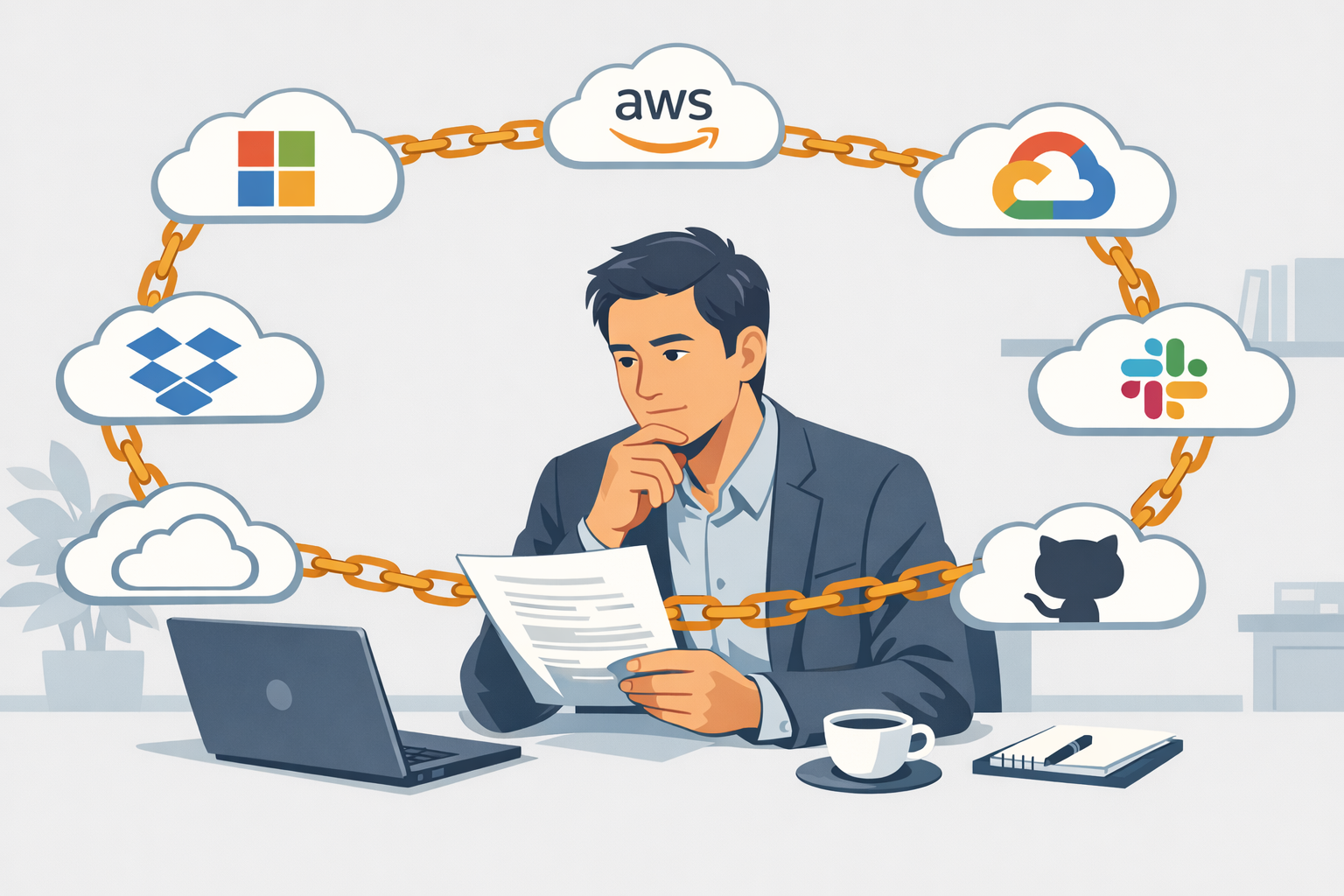
Nobody chooses vendor lock-in.
It arrives as a series of individually sensible decisions — a platform that solved an urgent problem, an integration that saved time, a feature that was too useful to give up. Each one reasonable. Each one adding another thread that ties your organisation to a vendor whose interests are not the same as yours.
By the time the problem becomes visible, leaving is expensive enough that most organisations don’t. They absorb the next price increase instead. They adapt to the next policy change. They stay.
Understanding how this happens — and how to avoid it before it takes hold — is one of the most valuable things a decision-maker can do before signing the next technology contract.
What vendor lock-in actually is
Vendor lock-in is the condition where switching away from a supplier has become so costly — in money, time, disruption, or data loss — that you no longer make the decision freely.
It’s not a single moment. It’s a threshold you cross gradually, usually without noticing, until one day a renewal arrives with a significant price increase and you realise that the practical alternative to accepting it is months of migration work, retraining staff, and potential data loss.
At that point you’re not a customer making a free choice. You’re a captive.
How it happens — the four mechanisms
Data lock-in is the most fundamental. Your data — patient records, student information, operational history, customer orders — lives inside the vendor’s platform in a format that is difficult or impossible to export cleanly. Moving means either losing historical data or paying the vendor to extract it for you.
Integration lock-in happens when your systems become dependent on a platform’s specific APIs, services, and tools. The more deeply integrated your operation becomes with a single vendor’s ecosystem, the more disruptive it is to leave any part of it. AWS is particularly effective at this — each managed service you adopt makes the others harder to leave.
Skills lock-in occurs when your team’s technical knowledge becomes specific to a platform. A team trained on Salesforce, or Workday, or a particular cloud provider’s tooling, carries knowledge that doesn’t transfer cleanly elsewhere. Switching means retraining, or hiring differently, or both.
Contractual lock-in is the explicit version — multi-year agreements, termination fees, auto-renewal clauses, and data retention terms that make exit expensive by design. Often buried in contracts that were signed quickly under deadline pressure.
Why regulated sectors are particularly exposed
For schools, clinics, and public institutions, vendor lock-in carries risks beyond the financial.
When your student records or patient data live inside a vendor’s platform, your ability to comply with GDPR obligations around data access, portability, and erasure depends on that vendor’s cooperation. If they change their export tools, retire a feature, or simply respond slowly to requests — your compliance posture is affected by their operational decisions, not yours.
For public sector organisations subject to procurement rules, lock-in also constrains future choices in ways that may conflict with transparency and competition requirements. A contract that was compliant when signed can create dependencies that make future compliant procurement practically impossible.
What avoiding it looks like in practice
Avoiding vendor lock-in isn’t about refusing to use external software. It’s about making deliberate choices at the beginning of every technology engagement that preserve your freedom to change later.
Own your data from day one. Before signing any contract, establish clearly: what format will your data be available in if you need to export it? Can you export it at any time, independently, without the vendor’s involvement? If the answer to either question is uncertain, treat that as a red flag.
Understand what you’re integrating with. Every integration with a vendor’s proprietary service is a thread. More threads mean more disruption if you leave. Where standards-based alternatives exist — open APIs, common data formats, widely supported protocols — prefer them over proprietary options.
Separate your infrastructure from your applications. If your software runs on infrastructure you control, changing the software doesn’t mean changing the infrastructure, and vice versa. This separation alone dramatically reduces the cost and complexity of switching any single component.
Read the exit clauses before signing. The termination terms, data return provisions, and transition assistance clauses in a vendor contract tell you a great deal about how that vendor thinks about your future independence. A vendor confident in their product makes it easy to leave. A vendor relying on lock-in makes it hard.
The infrastructure question
One of the most effective ways to reduce vendor dependency is to separate your application from the infrastructure it runs on.
Organisations that run their software on private infrastructure — rather than inside a vendor’s cloud platform — retain a fundamental freedom: they can change their software without changing where their data lives. They can move to a different application while keeping their operational history intact, in a location they control, under conditions they set.
This is not a technical luxury. For any organisation that expects to be operating in five or ten years — under conditions and with requirements that can’t be fully predicted today — it’s a form of institutional resilience.
The question to ask before every technology decision
Vendor lock-in is easiest to avoid before it begins. The question worth asking at the start of every technology engagement is simple:
If we needed to leave this vendor in eighteen months, what would that actually involve?
If the honest answer is “I’m not sure” or “it would be very difficult” — that’s the moment to negotiate better terms, find an alternative, or at minimum go in with clear eyes about the dependency you’re accepting.
The organisations that ask this question early make better technology decisions. The ones that don’t tend to find out why it mattered, eventually.
If you’re evaluating a technology decision and want to think through the lock-in implications before committing, I’m happy to work through it with you.
Connect on LinkedIn or reach out directly at hi@madalin.me.

Madalin
AI integrator🚀 Senior Architect | SRE & Database Expert | AI Orchestrator 👋 Building the future at the speed of thought. ⚡️ I don't just write code; I architect high-performance, bulletproof ecosystems. With a foundation in Systems Engineering and a mastery of Go and TypeScript, I bridge the gap between heavy-duty backend reliability and seamless, high-conversion frontends.
Continue the conversation
If this article reflects the challenges your organisation is navigating, explore more practical guidance across Madalin.