Scribes, Looms, and Compilers: We've Been Here Before
History shows us that automation doesn't eliminate jobs—it collapses costs, explodes demand, and forces skilled workers to evolve. Scribes didn't disappear after the printing press; they became editors and publishers.
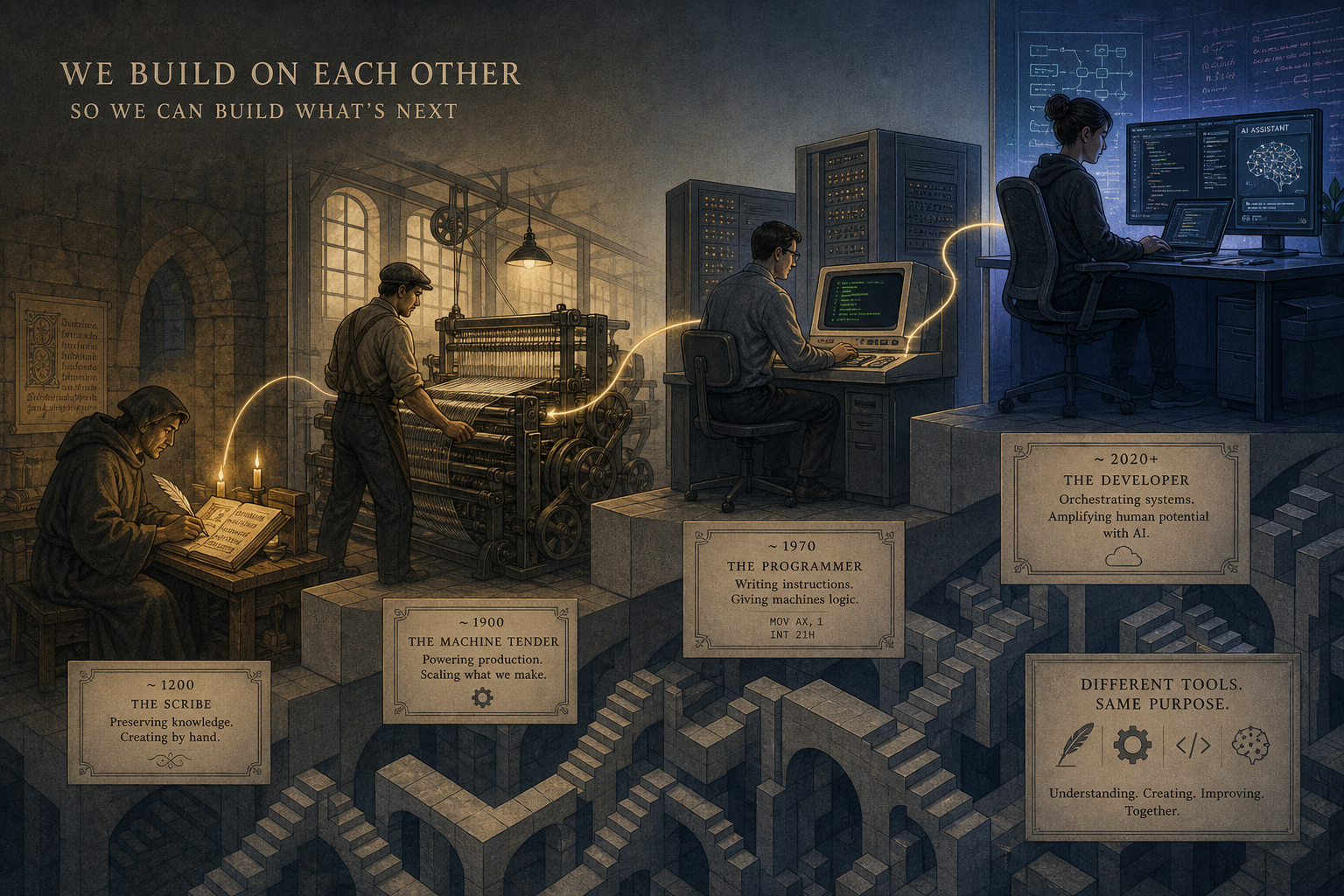
I write code and I keep servers alive for small businesses. Both of those jobs are supposedly being automated out of existence right now, depending on which corner of the internet you read. So I did what sysadmins do when something looks scary: I checked the logs. In this case, about 570 years of them.
Here’s what I found. Every single time a technology collapsed the cost of producing something, the same three-act play ran: skilled people panicked, demand for the thing exploded beyond anything the old cost structure allowed, and the humans who adapted moved up one level of abstraction — from producing the unit to directing, designing, and interpreting the units. The people who fought the change didn’t stop it. They just weren’t there for act three.
Let me show you the reruns.
Act One: The scribes should have been ruined
Before Gutenberg, around 1450, books were made by hand. Scribes and copyists were skilled, respected, well-paid professionals. The printing press should have destroyed them — it did their exact job, faster and cheaper, with fewer errors over time.
What actually happened: the price of a book collapsed, and demand went vertical. Europe produced a few million manuscript books in the entire 15th century. By the 18th century, printed books numbered in the hundreds of millions. That explosion created professions that had never existed: typesetters, punch cutters, printers, proofreaders, editors, publishers, booksellers — and eventually “author” as something you could actually get paid for.
The scribes who adapted became early printers and editors. They moved up the value chain. The ones who didn’t — and there was real resistance, guilds and clergy arguing that print would degrade quality and spread error — were not entirely wrong, by the way. Print did spread misinformation faster than ever before. They were just irrelevant. The press didn’t wait for their approval.
And the wealth-spread part matters: cheap books meant literacy stopped being an elite skill. Knowledge stopped being a luxury good. That’s not a side effect. That’s the whole point.
Act Two: The Luddites were right, and it didn’t matter
The Luddites get used as a lazy insult, so let’s be fair to them. Between 1811 and 1816, they weren’t stupid technophobes smashing machines because they feared progress. They were skilled weavers watching their wages collapse as power looms let factory owners replace them with cheaper, unskilled labor. Short-term, they genuinely suffered. Economists even have a name for it — the Engels pause: real wages for British workers stagnated for roughly the first fifty years of industrialization before the gains spread.
So the honest lesson is not “change is instantly good for everyone.” It isn’t. The honest lesson is that denial captured nothing. Cloth prices fell so far that demand exploded, and by the late 1800s the textile industry employed more people than before mechanization — in different roles. The people who positioned themselves for the new roles captured the gains. The people who smashed looms got fifty bad years and no looms.
If you’re going to bet, bet on the version of yourself that’s useful after the transition. Nobody else is coming.
Act Three: This already happened to programmers. Twice. Nobody remembers.
This is the one that should be tattooed on every “AI will kill programming” thread, because it’s the closest parallel to what’s happening right now, and it happened to us.
In the 1950s, high-level languages and compilers were literally marketed as “automatic programming.” Real programmers wrote assembly. Many of them dismissed FORTRAN as a toy that produced inefficient code and would deskill the profession. They were, in a narrow sense, correct — early compiled code was slower than hand-tuned assembly.
And it didn’t matter at all. By lowering the barrier to entry, compilers grew the profession from a few thousand specialists to tens of millions of developers. Every abstraction wave since ran the same script: the people who insisted on staying at the lower layer became a niche, and the people who embraced the abstraction and moved up — from writing loops to designing systems — multiplied their output.
AI coding tools are, structurally, another compiler moment. Natural language is the next abstraction layer. And exactly like a compiler, it never absolves you from understanding the machine underneath — because when things break, and they will, someone has to know what correct looks like. That someone is the job.
The pattern holds outside tech, too
Spreadsheets vs. bookkeeping clerks. VisiCalc and Lotus 1-2-3 wiped out a huge share of manual bookkeeping work through the 80s and 90s. Accounting and financial analysis employment grew over the same period. When running a financial model became nearly free, businesses ran thousands more of them — and needed people to interpret them. The task died; the profession expanded.
ATMs vs. bank tellers. My favorite, because it’s so counterintuitive. After ATMs rolled out en masse, US teller employment rose for decades. ATMs made each branch cheaper to operate, so banks opened far more branches, and tellers shifted from counting cash to relationship work. Automation lowered the cost of the unit, and the units multiplied.
Cars vs. the horse economy. Stable hands, farriers, harness makers, feed suppliers, street sweepers — an enormous economy, and it vanished. In exchange: manufacturing, mechanics, gas stations, road construction, trucking, logistics, everything the modern economy sits on. People genuinely stood on roadsides yelling “Get a horse!” at broken-down early automobiles. Remember that the next time someone screenshots an AI hallucination as proof the whole thing is a fad.
The deniers, in their own words
Predictions age badly, but some age spectacularly:
- 1920: The New York Times mocked rocket pioneer Robert Goddard, claiming rockets couldn’t work in a vacuum because there’s nothing to push against. They printed a correction in July 1969 — while Apollo 11 was on its way to the Moon.
- 1995: Clifford Stoll wrote a now-legendary Newsweek essay dismissing the internet, predicting online commerce and remote work would never take off. I’m writing this from home, for clients I’ve never met in person, and you’re probably reading it in a browser.
- 1998: Paul Krugman — a Nobel-winning economist — predicted the internet’s economic impact would be no greater than the fax machine’s. To his credit, he’s owned it since.
(You’ll notice I’m not quoting “the world needs maybe five computers” or “640K ought to be enough for anybody.” Both are likely apocryphal, and if you use them, some pedant will torch your whole argument over it. Stick to the documented ones — there are plenty.)
The honest paragraph
I’d be doing the Clifford Stoll thing in reverse if I pretended nobody ever loses. Telephone switchboard operators genuinely disappeared — hundreds of thousands of jobs, mostly gone by the 1980s, and research shows the affected workers took real income hits. That happened. It will happen to some tasks in our field too.
But notice what didn’t save a single switchboard operator’s career: insisting that automatic switching wouldn’t work. The claim here is not “nobody loses.” The claim is that the aggregate always grew, and individually, adaptation beat denial every single time it was tried. There is no historical example — not one — where the people refusing the tool outcompeted the people mastering it.
What this means if you write code or run servers
The mechanism behind every story above is the same, and once you see it you can’t unsee it:
- The technology collapses the cost of producing something.
- Demand for that thing explodes far beyond what the old cost structure allowed.
- Humans move up one abstraction level — from making the unit to directing and verifying the units.
Scribe → editor. Assembly programmer → software engineer. Bookkeeper → analyst. Teller → advisor. And now: code-typist → the person who designs the system, orchestrates the agents, and knows what correct looks like when the output is wrong.
The cost of producing code and running infrastructure is collapsing right now, in front of us. If history rhymes even slightly, that doesn’t mean less software and fewer systems. It means an absurd amount more — more small businesses that can afford custom tools, more automation for people who could never pay agency rates, more infrastructure that needs someone who actually understands it standing behind the curtain.
The scribes who became printers didn’t love the press because it was comfortable. They loved it because they saw what a hundred million books meant before everyone else did.
Your move.

Madalin
AI integrator🚀 Senior Architect | SRE & Database Expert | AI Orchestrator 👋 Building the future at the speed of thought. ⚡️ I don't just write code; I architect high-performance, bulletproof ecosystems. With a foundation in Systems Engineering and a mastery of Go and TypeScript, I bridge the gap between heavy-duty backend reliability and seamless, high-conversion frontends.
Continue the conversation
If this article reflects the challenges your organisation is navigating, explore more practical guidance across Madalin.