The Debian Lifecycle: Why a Two-Year Upgrade Rhythm Is a Business Advantage
Debian’s two-year release cycle creates a calm, predictable upgrade window—helping businesses avoid rushed migrations, security risks, and costly emergency support.
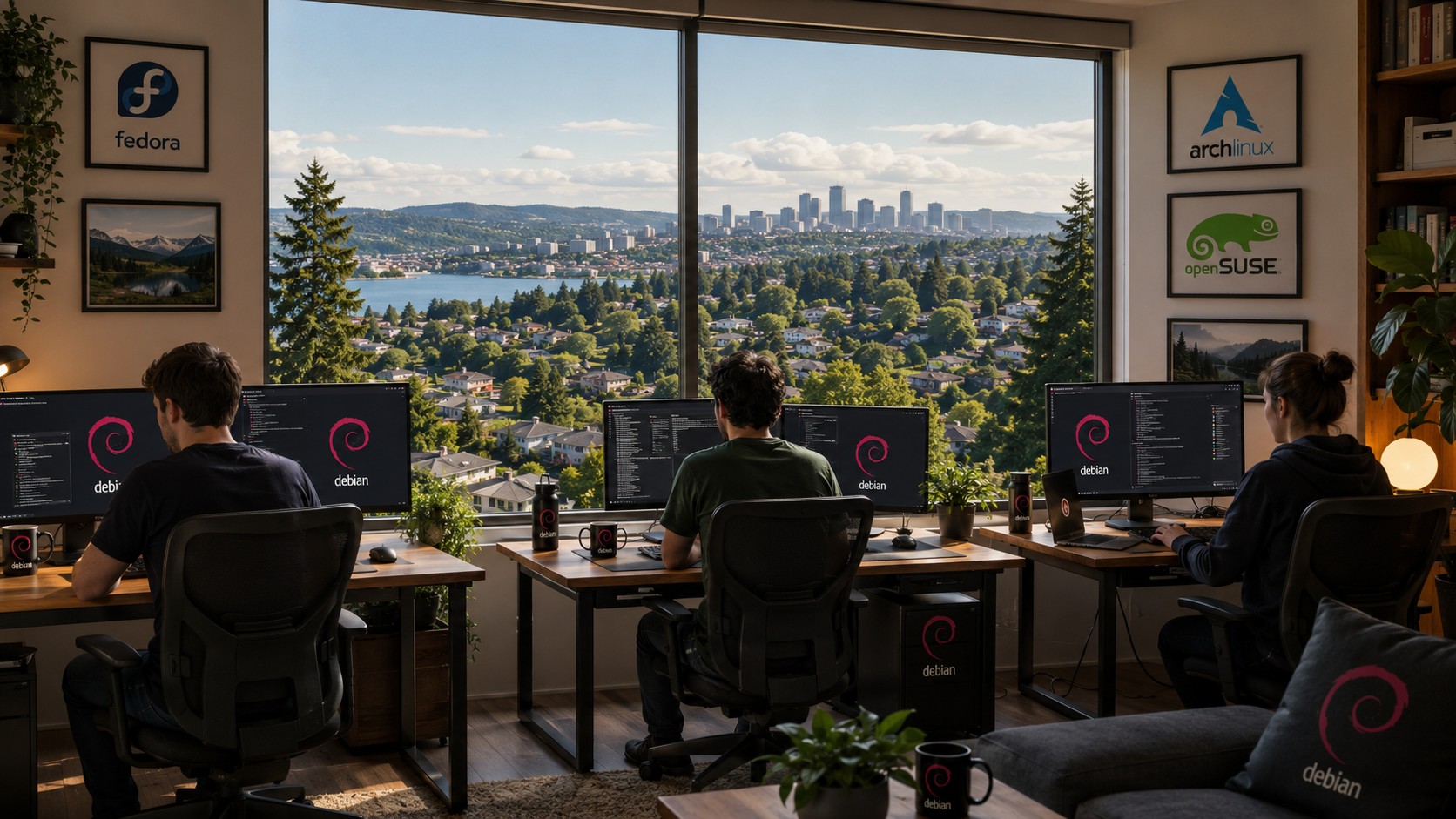
Every server runs on an operating system, and every operating system has a lifetime. For businesses running on Debian Linux — as most of my clients do — understanding that lifetime is the difference between calm, predictable maintenance and expensive emergency projects. In this article I’ll explain how the Debian release cycle works, and why its rhythm, far from being a burden, is one of the best planning tools a small business can get for free.
The lifecycle in plain terms
Debian publishes a new major version roughly every two years. From the moment a version is released, it moves through three phases:
Full support — about three years. The Debian project actively maintains the release. Security fixes arrive promptly and at no cost. This is where production systems should live.
Long-term support (LTS) — about two more years. A dedicated team continues providing free security fixes. The system remains safe to operate, but receives protection only, no improvements. A comfortable buffer — not a destination.
Extended paid support — up to five further years. A commercial service (run by Freexian) can keep patching old releases for organisations that truly cannot upgrade. Its pricing rises every six months by design, precisely to encourage migration. Think of it as insurance for exceptional cases, never as a strategy.
A concrete example: Debian 12 was released in mid-2023, entered its free LTS phase in mid-2026, and is expected to remain supported at no cost until around mid-2028. Its successor is already available — which means the upgrade window is open now.
The overlap is the opportunity
Here is the detail that turns this schedule into a planning advantage: releases every two years combined with three years of full support means there is always at least a year of overlap during which both the current and the previous version are fully maintained.
That overlap is the ideal upgrade window. You migrate calmly, one system at a time, with the freedom to pause if something needs attention — instead of racing a deadline. A business that adopts a simple rule — upgrade the full infrastructure once every two years, during the overlap — never faces an end-of-support emergency again. The work becomes a modest, recurring line item that can be scheduled around business priorities, rather than an unplanned rescue effort with an unplanned invoice.
Stability as a feature, not a compromise
Debian’s conservative pace sometimes gets framed as a drawback: the components it ships are not the newest available. For business infrastructure, this is exactly backwards.
By the time software lands in a Debian stable release, it has been tested, integrated, and hardened well beyond what any individual business could achieve on its own. Upgrading every two years means you advance continuously — new capabilities, current security architecture, modern tooling — but always onto ground that thousands of others have walked first. You get progress with minimal surprise, which is the correct trade-off for systems that make money while nobody is watching them.
The hidden benefit: healthier internal applications
There is a second-order effect that I find is rarely discussed but matters enormously for any business that develops its own software.
Applications do not age gracefully on their own. Language runtimes move on, libraries deprecate interfaces, security practices evolve. Without an external forcing function, internal applications tend to drift until they only run on an ancient system nobody dares to touch — at which point both the app and the server become unupgradeable together. Every administrator has met this server.
A fixed two-year infrastructure cadence quietly prevents this. Each upgrade cycle gives the development team a predictable, scheduled moment to do the small refactorings needed to support the new platform: bump a runtime version, replace a deprecated call, update a dependency. Because the interval is short and known in advance, each round of work stays small. Maintenance happens continuously in modest doses, instead of accumulating into a rewrite. The operating system’s calendar becomes, in effect, a free maintenance schedule for your own codebase.
What this looks like in practice
The management approach I recommend to every client fits in four habits:
- Keep an inventory with dates. Every server has a recorded OS version and a known support horizon. Lifecycle management becomes a calendar exercise, not guesswork.
- Upgrade during the overlap, every two years. Full infrastructure, planned around your business calendar — never around an expiry date.
- Couple app maintenance to the same cycle. Each upgrade round includes the small application updates needed to stay current.
- Treat paid extended support as an exception with a name and an exit date. If one system genuinely cannot move on schedule, the paid extension buys time safely — but its rising cost means it should always come with a migration plan attached.
Where that leaves you
If you’re on Debian 12 today, you are inside the free LTS window and secure — but the successor is out, the overlap is running, and the comfortable moment to migrate is the coming months, not 2028. An unsupported system doesn’t stop working; it stops being defended. And for any EU business handling personal data, running undefended systems is very hard to reconcile with GDPR’s requirement for appropriate technical security measures.
The Debian project hands every business a predictable, honest schedule at no cost. The only thing it asks in return is that you actually use it.
Questions about planning an upgrade cycle for your own infrastructure? Get in touch — this is exactly the kind of work I do.

Madalin
AI integrator🚀 Senior Architect | SRE & Database Expert | AI Orchestrator 👋 Building the future at the speed of thought. ⚡️ I don't just write code; I architect high-performance, bulletproof ecosystems. With a foundation in Systems Engineering and a mastery of Go and TypeScript, I bridge the gap between heavy-duty backend reliability and seamless, high-conversion frontends.
Continue the conversation
If this article reflects the challenges your organisation is navigating, explore more practical guidance across Madalin.