When AlmaLinux Makes Sense: Long-Lived Services and the Ten-Year Lifecycle
AlmaLinux’s ten-year lifecycle is ideal for stateful services—databases and storage clusters—where stability matters more than frequent OS upgrades.
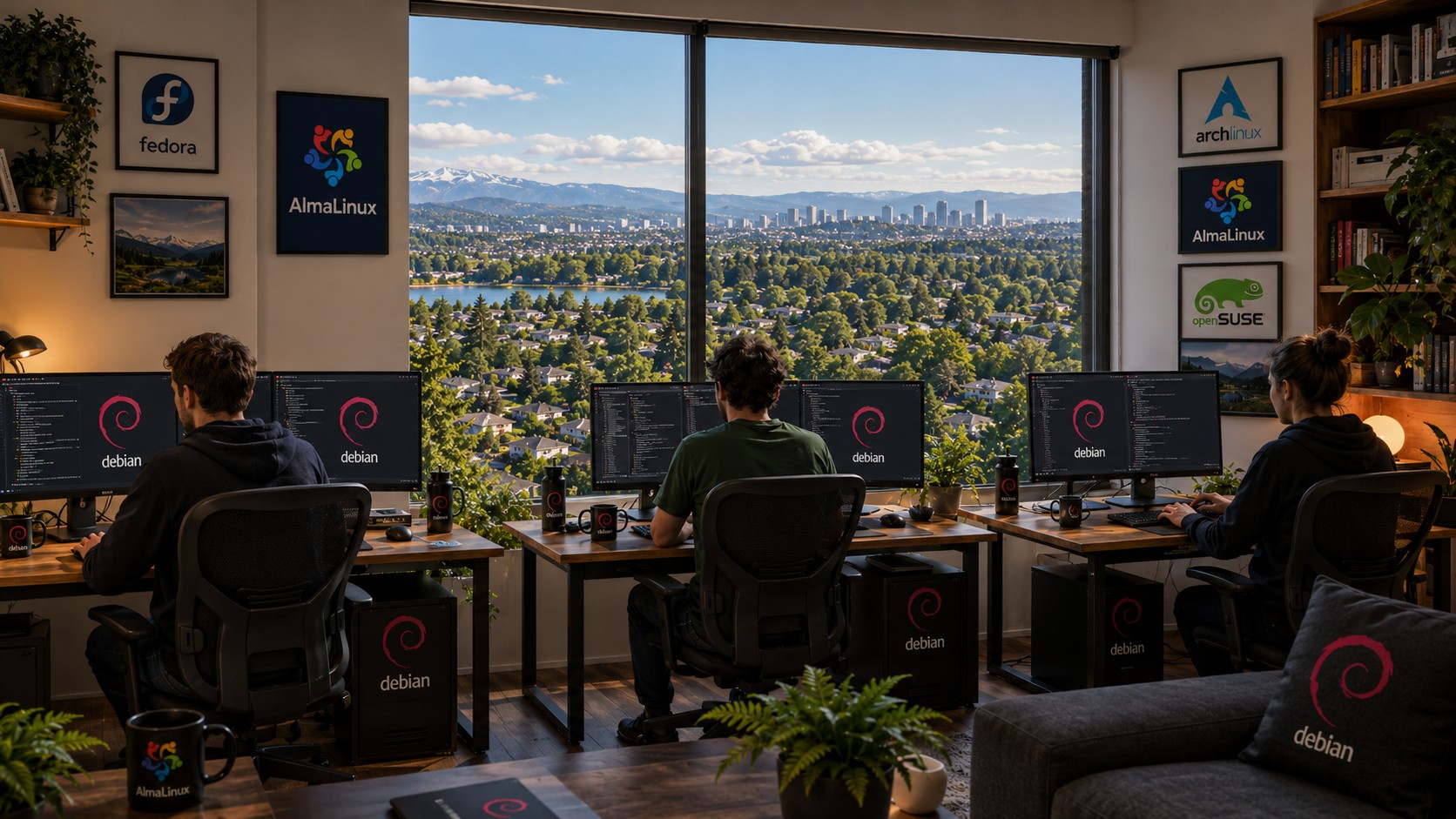
This article is a follow-up to [The Debian Lifecycle: Why a Two-Year Upgrade Rhythm Is a Business Advantage]. There I argued that Debian’s predictable cadence is a planning tool, not a burden. This time I want to be fair to the other philosophy — because for a specific class of services, the opposite approach wins.
Two philosophies, not a ranking
Debian and AlmaLinux answer the same question — “how long should an operating system live?” — with opposite numbers, and both answers are correct for different workloads.
Debian releases every two years and supports each version for about five. AlmaLinux, which tracks Red Hat Enterprise Linux release for release, supports each major version for roughly ten years — for example, version 9 receives security updates until 2032, and version 10 until 2035 — at zero licensing cost. Where Debian’s rhythm keeps a fleet moving in small, frequent, low-risk steps, AlmaLinux’s long horizon lets individual systems stand still, deliberately, for close to a decade.
The question is never “which distribution is better.” It is: does this particular service benefit from moving often, or from not moving at all?
Where AlmaLinux should be preferred
The answer falls out of one distinction: how does the service’s state travel?
If a system is stateless or easily rebuilt — web and application tiers, container and Kubernetes nodes, anything redeployed routinely — the OS lifecycle barely matters, and Debian’s fresher packages and lighter upgrade path serve it best. But if a system’s value lives in the data it holds, and that data migrates through the application’s own mechanisms rather than through OS upgrades, the calculus flips. These services want an OS that stays put:
- Database clusters — PostgreSQL or MariaDB, where new-version transitions happen by building fresh nodes and replicating data across, never by upgrading the OS in place
- Object storage clusters — MinIO or Ceph, where data rebalances onto new nodes natively (Ceph in particular is primarily developed and tested on the RHEL family)
- Virtualization hosts — long-lived KVM/libvirt hypervisors you want to install once and trust
- Identity and directory services — centralized authentication boxes that everything else depends on
- Single-purpose appliance machines — the backup target, the monitoring box, the on-premise server visited twice a year
For everything on that list, AlmaLinux’s model delivers a set of benefits that shorter cycles structurally cannot. Here they are.
The OS outlives your migration plan — not the other way around
The biggest hidden cost of any OS lifecycle is that it forces movement on infrastructure that hates moving. A ten-year security window inverts this: you migrate when the application gives you a reason — a new database major version worth having, a hardware refresh, a budget cycle — and the operating system is never the deadline.
Consider the database case concretely. The healthiest way to move a PostgreSQL or MariaDB cluster to a new major version is not an in-place upgrade but a fresh install: build new nodes on the new OS release, join them through replication, switch over calmly, retire the old ones. Under AlmaLinux, the old nodes remain fully patched for years while the new generation bakes. Developers get a wide, unhurried window to test applications against the new database version and refactor on their own schedule. Nobody races a support expiry — and rushed migrations are precisely where data-layer incidents come from.
One technical note for PostgreSQL specifically: when replacing nodes across OS generations, changes in system text-sorting libraries can silently corrupt indexes on physically replicated data. Use logical replication for the transition, plan a reindex on the new nodes, or standardize on ICU collations. This applies whatever distribution you run — but it matters most in exactly this fresh-node workflow.
Stability guarantees that stateful services actually need
The RHEL-family model is not merely “long support.” Within a major version, the core interfaces — kernel, C library, cryptographic libraries, system services — are frozen, with security fixes backported rather than versions bumped. What you validated on deployment day is what runs in year six.
For databases, that means no surprise behavior changes in the libraries beneath your data files mid-lifecycle. For virtualization, it means running the reference platform: the KVM/libvirt stack is developed largely by Red Hat engineers on this family of systems, so migration quirks and driver behavior are first-tested exactly where you run them. For storage clusters, the same holds for Ceph. Fewer “works upstream, breaks in packaging” surprises — on the layer that holds your clients’ data.
Predictability you can put in a contract
AlmaLinux’s lifecycle dates are published a decade in advance. For a small business, that enables a sentence most IT proposals cannot honestly contain: “This database server is security-supported until May 2032, at no licensing cost, and here is its planned refresh date.” Simple, verifiable, and free of the support-tier fine print.
It also protects the client beyond any single provider. A long-lived AlmaLinux system is a boring, standard, documented machine in the largest enterprise-Linux ecosystem there is — meaning any experienced administrator can inherit it. For a business relying on a small IT partner, that continuity is worth more than most feature lists.
Fresh installs as a feature, not a workaround
Because this model never requires in-place major upgrades, every node is a clean installation of a known state. No configuration sediment accumulated across years of upgrades; no mystery files inherited from three versions ago. Paired with configuration management, each generation of database or storage nodes is fully reproducible from scratch.
That discipline pays three times over: a smaller, auditable security surface; disaster-recovery confidence, because rebuild-from-automation is proven at every migration cycle rather than hoped-for; and a better developer experience, because application teams always test against a pristine reference environment instead of an archaeological one.
Security architecture suited to boxes you rarely visit
AlmaLinux ships with SELinux enforcing by default, carrying mature, workload-specific confinement policies for exactly these services — databases, virtualization, standard daemons — battle-tested at enterprise scale. On a machine that runs for years with only occasional hands-on attention, mandatory access control configured once and never fought again is genuine defense in depth. For businesses handling personal data under GDPR, documented and enforced process confinement on the systems that store that data is also a concrete, demonstrable technical measure — the kind auditors and clients alike understand.
The economics, small-business sized
Everything above is the enterprise Linux lifecycle at zero licensing cost, stewarded by a nonprofit foundation with broad corporate backing rather than a single vendor’s goodwill. For the machine types in question — a database pair, a backup target, a hypervisor — the arithmetic is pleasantly short: no subscriptions, no paid extended-support quotes, one OS decision per hardware generation. Maintenance spending shifts away from recurring OS migrations and toward the transitions that actually deliver value: database major versions, hardware refreshes, capacity growth.
The honest fine print
Two things keep this from being a blanket recommendation.
First, the long runway removes the forcing function I praised in the Debian article. Nothing on a ten-year OS nudges your internally developed applications toward regular small refactorings — so if you adopt AlmaLinux for the data layer, impose your own refresh cadence on the software above it. Untouchable legacy servers are made of exactly this comfort.
Second, these benefits accrue per service, but the cost of running a second distribution — a different package manager, SELinux instead of AppArmor, parallel automation roles — accrues per fleet. For two database clusters, the overhead likely outweighs the gain, and the fresh-node migration pattern works on Debian too, just with a narrower overlap window. The case gets strong when the long-lived stateful layer grows: several database clusters, storage nodes, hypervisors, appliance boxes at client premises.
The two articles together reduce to one principle: match the lifecycle to the workload. Fast-moving, stateless, frequently rebuilt — Debian’s two-year rhythm keeps it healthy. Long-lived, stateful, migrated through its own replication — AlmaLinux’s decade lets it stand still safely. Most real infrastructures, honestly assessed, contain both kinds.
Running databases or storage that never seem to find the right moment to upgrade? That planning is exactly the kind of work I do — get in touch.

Madalin
AI integrator🚀 Senior Architect | SRE & Database Expert | AI Orchestrator 👋 Building the future at the speed of thought. ⚡️ I don't just write code; I architect high-performance, bulletproof ecosystems. With a foundation in Systems Engineering and a mastery of Go and TypeScript, I bridge the gap between heavy-duty backend reliability and seamless, high-conversion frontends.
Continue the conversation
If this article reflects the challenges your organisation is navigating, explore more practical guidance across Madalin.